





Tanja Kallio: Boosting the hydrogen revolution

The production of hydrogen with electrolysers is one of the interesting ways of converting renewable energy into a reusable form. One of the questions under investigation is how to make the process more energy efficient. The Power-to-X focus area in the Green Electrification 2035 programme delves into precisely these kinds of issues. Key part of the work is the Finnish hydrogen know-how development project FinH2, which involves Aalto University, VTT and LUT – and ABB as a driving force.
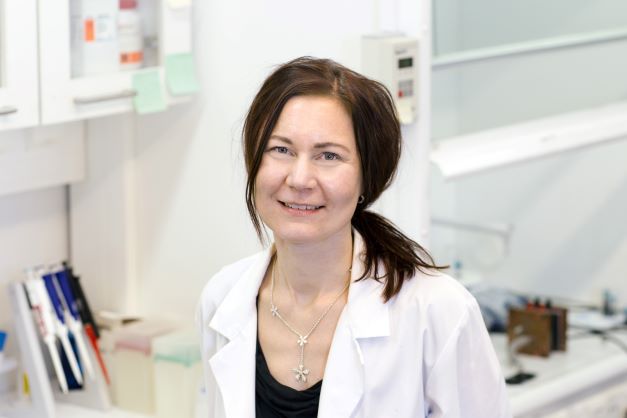
Professor Tanja Kallio from the Department of Chemistry and Materials Science is in the forefront of boosting the hydrogen revolution. Kallio is not only one of the directors of the newly established Aalto University Hydrogen Innovation Centre, but is also developing new methods for hydrogen electrolysis with her research team in the FinH2 project.
The researchers are particularly interested in two of the most advanced electrolysis technologies, namely the well-established alkaline electrolysis and the emerging polymer membrane electrolysis (PEM). Kallio says these two are currently the most mature electrolysis technologies and she sees them sharing the market in the coming years.
"Our task is to develop an electrocatalyst. The emerging technology, the PEM electrolyzer, uses noble metals and there are critical problems with their sufficiency, both geopolitically and quantitatively. So we are trying to develop a new catalyst without these noble metals", Kallio explains.
At the moment, the development work is aimed at not using noble metals at all in the catalyst, but Kallio says that the alternative is also to use fewer noble metals. In particular, research is under way to improve the durability of the catalyst without the metals. It’s also under consideration, how much not using the noble metals in catalysts can reduce efficiency to still be within acceptable limits.
However, there are still many other issues on the road to a hydrogen economy and a greener society that need to be addressed.
"The green transition means transferring to a mineral economy, as wind power, solar power, batteries, hydrogen technology; they all rely on different metals and minerals. We need to re-evaluate material supplies and chains, what material is worth using and where. And I don't see these issues being resolved in the short term", says Kallio.
To address the issues of the hydrogen economy and the green transition, Aalto University has set up a Hydrogen Innovation Centre, which brings together experts from different universities to tackle these critical issues together. Kallio sees a great strength in Aalto University's multidisciplinarity.
"We have hydrogen expertise in many different schools, which gives us the opportunity to really collaborate: we already have a chain of experts from the molecular level to the system level. Now we are forming a kind of umbrella for hydrogen research, bringing together professors and researchers to work on joint projects in hydrogen innovation," says Kallio.
Aalto researchers accelerating the green transition in ABB-led programme’s projects
The Green Electrification 2035 programme aims to develop solutions for the green transition.

Strategic corporate partner ABB
Aalto University and ABB cooperate in many different areas, and all six Aalto schools are involved. The cooperation has continued for more than 130 years.

Aalto University Hydrogen Innovation Centre
The Hydrogen Innovation Centre works to enable a sustainable hydrogen society by facilitating world-leading research at Aalto, and collaboration between our research community, companies, policymakers and external research organizations.

Read more news

Environmental Structure of the Year 2025 Award goes to Kalasatama-Pasila tramway
The award is given in recognition of meritorious design and implementation of the built environment. Experts from Aalto University developed sustainability solutions for the project.
A Bloc becomes a “living lab” for Aalto students: Entrepreneurial Futures course and Cafetoria join forces in pop-up collaboration
A Bloc’s pop-up space turned into a hands-on learning environment when Entrepreneurial Futures course and Cafetoria co-created a pop-up.A survey on users' experiences of Mykanta in collaboration between Aalto University and Kela
Senior university lecturer Sari Kujala's research group is exploring, in collaboration with Kela, users' experiences with the Mykanta online patient portal and the MyKanta mobile application.